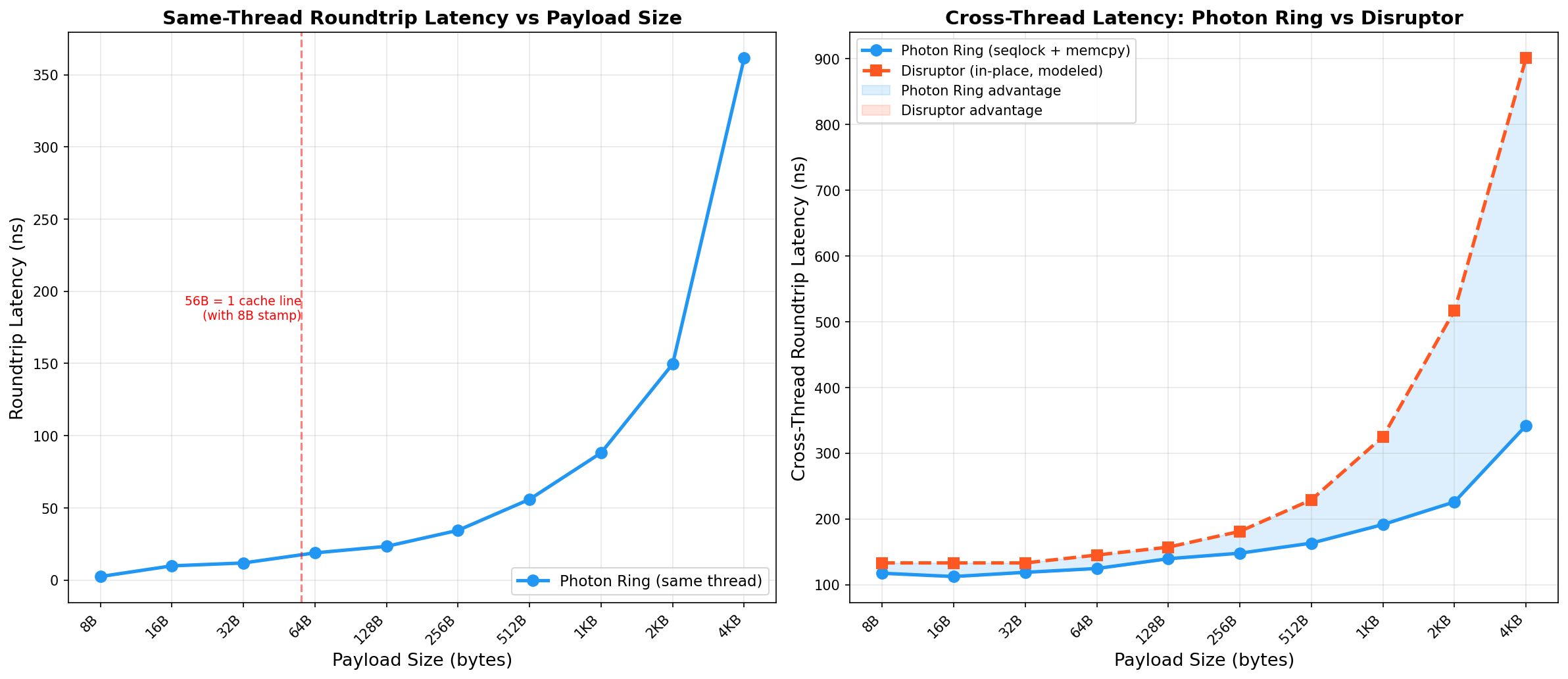
Where this fits
What inter-thread messaging designs cost, and which problem each one solves
Approaches
Inter-thread messaging designs usually pay for at least one expensive property
on the hot path. Which one you can afford is the real choice.
| Approach | Write cost | Read cost | Allocation | Solves |
|---|
| Locked queue | Lock acquisition | Lock acquisition |
Dynamic growth | General handoff, any payload |
| Lock-free queue | CAS on head | CAS on tail |
None | Point-to-point: one receiver owns each message |
| Shared sequence barrier | Sequence claim, then a fold over every consumer's position |
Barrier spin | None | Ordered pipelines with dependent stages |
| Stamped slots (this crate) | Stamp + payload write |
Stamp check, private cursor | None |
Broadcast: every subscriber sees every message, uncoordinated |
Pre-allocated rings are what removed allocator overhead from this problem, and
the shared sequence barrier is the classic way to order consumers on one: every
consumer publishes its position, and the producer folds them into a minimum before
it may overwrite a slot. That is cheap with one consumer and grows with the audience.
Moving validation into each slot trades the ordering for independence — subscribers
keep private cursors and never consult one another — which is also what makes
per-consumer delivery contracts, dead-consumer recovery and hot attach possible,
since there is no shared minimum for a stalled consumer to poison.
Fanout scaling
Delivering one message to N consumers is O(N) work somewhere — the question is
where it lands. Time to publish one message and have all N consumers observe it,
in nanoseconds, single-threaded and in-cache. This measures protocol overhead,
not real cross-core fanout latency.
| N consumers | 1 | 2 | 4 | 8 | 16 | 32 | Marginal |
|---|
| Photon Ring |
3.9 | 5.9 | 8.5 |
14.9 | 25.9 | 50.2 |
1.5 ns |
tokio::sync::broadcast 1.53 |
47.7 | 65.5 | 99.2 | 167.3 | 306.9 | 579.6 | 17.2 ns |
crossbeam-channel 0.5, one per consumer |
22.3 | 44.3 | 87.8 | 176.5 | 351.3 | 701.9 | 21.9 ns |
flume 0.11, one per consumer |
27.4 | 53.9 | 108.7 | 217.6 | 428.4 | 859.3 | 26.8 ns |
Reading this honestly:
the marginal column is what matters — a subscriber here costs about one cursor
read and one stamp check, because subscribers share no state, so the producer's work
does not grow with the audience. A point-to-point queue is not broadcast at all: fanning
out means the producer sends once per consumer, so that row shows what broadcast costs
on a queue that does not do broadcast, rather than a race those libraries lost. They
solve the different and equally real problem of exactly one receiver owning each message.
Reproduce with cargo bench --bench fanout_scaling.
Cross-thread fanout
The table above isolates protocol cost in cache. This is the deployed shape: one
producer, N consumer threads on their own cores, 100k messages, every consumer
accounting for all of them. Total milliseconds, lower is better.
| Library | Delivery | N=1 | N=2 | N=4 | N=8 |
|---|
| Photon Ring | lossless |
0.49 | 0.52 | 0.58 | 2.62 |
disruptor 4.0 | lossless |
0.45 | 2.94 | 6.99 | 12.15 |
crossbeam-channel 0.5, one per consumer | lossless |
1.39 | 14.90 | 27.92 | 46.79 |
tokio::sync::broadcast 1.53 | lossy |
8.23 | 8.61 | 33.86 | 119.47 |
Where this crate loses, and what is not established:
at a single consumer disruptor is faster. Its consumers coordinate through
a shared sequence barrier, and with one consumer there is nothing to coordinate, so the
barrier costs nothing while this crate still pays for its per-slot stamps. From two
consumers onward the producer must fold every consumer's position into a minimum before
it may publish, and that cost grows with the audience.
Separately, the jump in this crate's own N=8 figure is not established as architectural:
that run put nine threads on a sixteen-thread machine that was not otherwise idle, and it
needs a pinned rerun on a quiet box. And the lossy row is not comparable to the three
lossless ones — it drops under pressure instead of applying backpressure, so compare
it against this crate's lossy channel() rather than channel_bounded().
Reproduce with cargo bench --bench fanout_threaded.
Capabilities
| Capability | Photon Ring |
|---|
| Delivery | Broadcast — every subscriber sees every message |
| Payloads | Pod on the seqlock ring; any Send type on an event ring |
| Per-consumer contracts | Gating and non-gating subscribers on one ring |
| Consumer failure | A dead consumer releases the publisher |
| Hot attach | Subscribe to and detach from a running ring |
| Backpressure | Optional, per subscriber |
| Topologies | Pipelines, fan-out, managed terminal consumers |
| Topic bus | Named topics, and a typed bus for per-topic payload types |
| Multi-producer | Yes |
no_std | Yes, with alloc |
| Verification | Miri and loom gated in CI; a TLA+ model of the seqlock checked by hand |
Design constraints
| Constraint |
Rationale |
| T: Pod |
Every bit pattern must be valid. Torn reads from speculative seqlock copies are safe to reject without UB. |
| Power-of-two capacity |
Indexing uses seq & mask instead of %, avoiding division on the hot path. |
| Single producer by default |
&mut self enforces one writer at the type level. No CAS on the write path. |
| Lossy overflow by default |
Publisher never blocks. Slow subscribers detect drops via TryRecvError::Lagged. |
| 64-bit atomics required |
The seqlock stamp is a u64. Platforms without atomic 64-bit operations are not supported. |
When to choose crossbeam-channel instead:
If each message should be consumed by exactly one receiver (point-to-point ownership transfer), use
crossbeam-channel.
Photon Ring is optimised for broadcast: every subscriber sees the same stream with independent cursors and no contention.